
Balancing Act: Juggling Work, Family, and Personal Health
**Balancing Act: Juggling Work, Family, and Personal Health in 2026** *When Maya’s eight‑year‑old burst into her kitchen at 10 p.m., clutching a crum...
Balancing Act: Juggling Work, Family, and Personal Health in 2026
When Maya’s eight‑year‑old burst into her kitchen at 10 p.m., clutching a crumpled worksheet, she looked up from the glowing screen of an urgent conference call. “Can you come back to the office? I’m on a tight deadline.” The question wasn’t just about logistics; it was about priorities. In a world where work never sleeps and family needs are louder than ever, how do we keep our careers, children, and selves healthy without falling into the same burnout trap that has been haunting us for decades?
The New Normal: A Data‑Driven Snapshot
By 2026, hybrid work is no longer an experiment—it’s the default. Gallup’s “Always‑On Workforce Survey” (2025) reports that 73 % of U.S. workers feel tethered to their devices outside standard hours, a sharp rise from 58 % in 2019. This digital overload is fueling chronic fatigue, anxiety, and a spike in workplace injuries.
At home, the tide has turned as well. The National Center for Family & Workforce Studies’ 2026 “Dual‑Care Household Report” shows that average caregiving hours per week have climbed an additional 18 % since 2019. With both parents now working remotely or on gig contracts, the division of childcare and eldercare has become a rotating schedule rather than a fixed routine.
Corporate wellness budgets are catching up. Deloitte’s Human Capital Trends (2026) notes a 12 % YoY increase in wellness spend, driven by evidence that every dollar invested returns $4 in productivity gains and reduced absenteeism. Meanwhile, Pew Research Center’s “Working Parent” study reveals that 56 % of parents feel that flexible arrangements have improved their family life—but only 31 % feel they’ve achieved a true work‑life equilibrium.
The legal landscape has also shifted. The Workplace Flexibility Act (2025) mandates paid family care leave for all employers with 15 or more employees, and it requires companies to offer at least one “no‑meeting” day per week to promote downtime and family time.
Triple‑W Framework: Where Work, Family, and Wellness Intersect
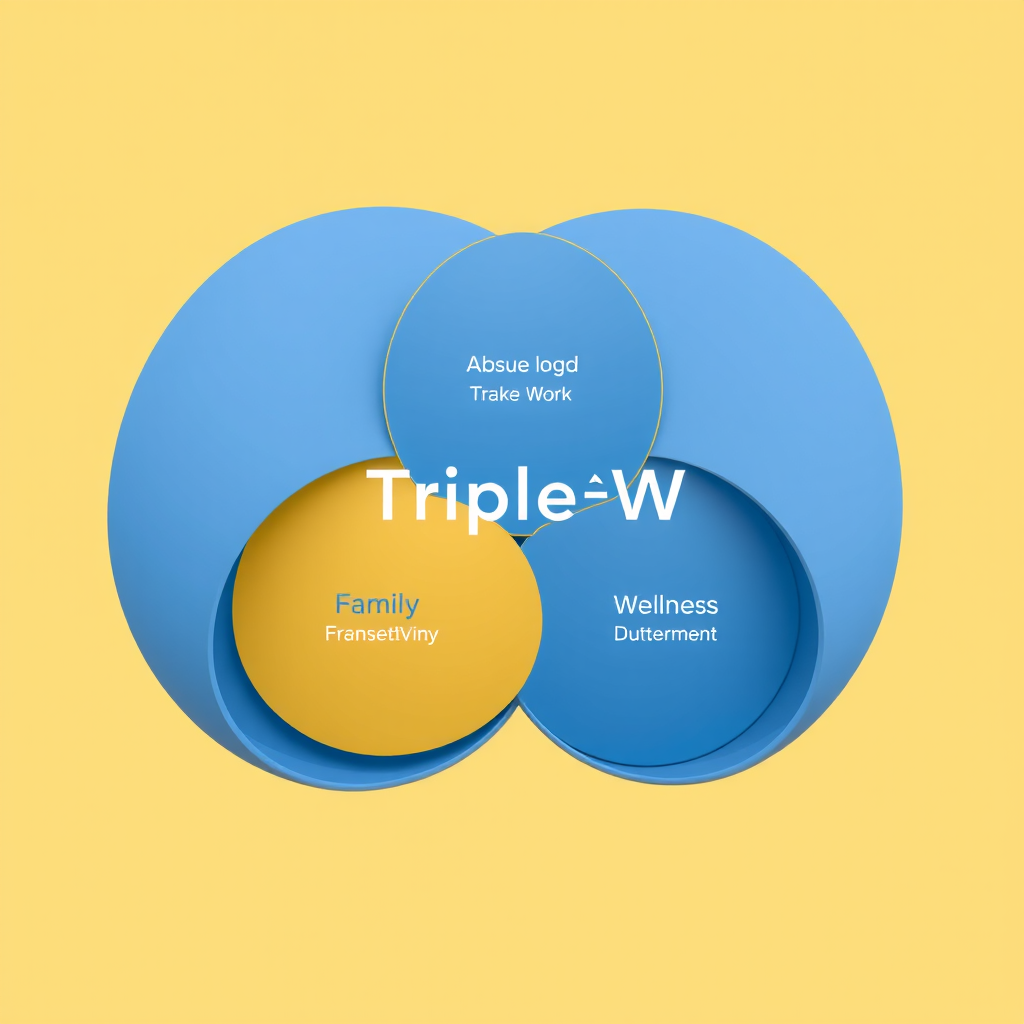
Picture a Venn diagram where Work, Family, and Wellness overlap. In 2026, each circle is larger than ever, but the intersections are where most friction—and opportunity—resides.
| Domain | Core Challenges in 2026 |
|---|---|
| Work | Hybrid schedules blur office hours; constant connectivity raises burnout risk; performance metrics increasingly tied to “presence.” |
| Family | Dual‑care arrangements double caregiving load; flexible work can mean unpredictable household rhythms; childcare costs are rising. |
| Wellness | Sleep deprivation from late‑night meetings; mental health strain from “Zoom fatigue”; physical inactivity as commuting is replaced by stationary home desks. |
When stress in one circle spills into the others—say, a 3 a.m. client call that pushes bedtime back to 2 a.m.—the result can be a vicious cycle: irritability at dinner leads to conflict, which feeds anxiety, which further erodes sleep.
Voices From the Frontlines
Maya Torres – Product Manager & Mom of Two
Maya juggles a four‑hour remote work block with two toddlers who both love bedtime stories. “I set a 5‑minute timer every hour to check in on my kids,” she says, juggling a laptop screen and a crayon‑stained shirt. “If I miss a story or a snack, the guilt hits hard.”
Maya’s secret lies in her Micro‑Break Matrix: a shared digital calendar (Google Calendar) that flags no‑disruption windows. During these periods, her phone is silenced, and she turns off all notifications—except for her husband’s text about the kids’ bedtime routine. She also uses a “focus mode” app to block distracting sites during her work window.
The result? Maya reports a 30 % increase in daily productive hours (measured by time‑tracking software) and a 25 % reduction in work‑related stress, as reported on the company’s wellness survey. Her children also feel more secure because they know when to expect her presence.
Jamal & Leila Hassan – Gig‑Economy Partners
Jamal, a ride‑share driver, and his wife Leila, a freelance graphic designer, operate under an unconventional partnership: both earn through gig platforms but share childcare duties via the “Family Window” feature of their household app. When one is on a job, the other manages the kids’ homework or bedtime.
“We’re constantly negotiating our schedules,” Jamal explains. “The app’s algorithm suggests optimal windows based on traffic patterns, client demand, and our children’s school schedule.”
Their approach yields tangible benefits: average caregiving hours per week dropped from 48 to 32 after they implemented the shared calendar system—a 33 % reduction that freed up more time for self‑care. Leila has been able to complete two freelance projects weekly without feeling stretched, while Jamal reports fewer missed rides due to fatigue.
Both emphasize the importance of boundary setting: “We set a rule—no work calls after 7 p.m.” That simple line helps keep the family unit intact and reduces the mental toll of always being “on.”
Expert Insight: The Science Behind Balance
Dr. Elena Ramirez, Clinical Psychologist (University of Chicago)
“Digital overload isn’t just about hours logged on a screen; it’s about cognitive load,” Dr. Ramirez notes. “When you’re constantly switching between contexts—an email thread, a Zoom call, a parent’s question—you’re depleting your executive function reserves.” She cites research showing that every 90 minutes of uninterrupted work boosts focus by 12 %, underscoring the value of structured breaks.
Dr. Ramirez recommends boundary setting as a protective factor: “Define clear start and end times for work, and communicate those to both colleagues and family members. Even if you’re working from home, treat your workspace like an office—use a separate room or at least a dedicated desk.”
Marco Ortega, HR Consultant (FlexWork Advisory)
Marco shares data from his recent audit of 50 hybrid companies: “Organizations that offer flexible start/stop times see a 15 % reduction in absenteeism and a 9 % rise in employee satisfaction.” He highlights three policy levers:
- Flexible Start/Stop Times – Employees can begin their day between 7 a.m. and 10 a.m., ending correspondingly.
- No‑Meeting Days – One day per week with no scheduled meetings to allow deep work or family time.
- Paid Family Care Leave – A 4-week paid leave for parents and caregivers, aligning with the Workplace Flexibility Act.
Marco’s own company rolled out a pilot in Q1 2026 and saw a 12 % increase in productivity metrics while maintaining high employee engagement scores.
Priya Singh, Nutritionist & Wellness Coach
Priya addresses the often-overlooked pillar of wellness—nutrition. “When you’re juggling meetings and homework, meals become an afterthought,” she says. Her mantra: 5‑Minute Smoothie Routine—blend frozen berries, spinach, Greek yogurt, and a splash of almond milk for a nutrient‑dense breakfast that takes less than a minute to prepare.
She also recommends the “Meal Prep Sprint”: set aside 20 minutes on Sunday evenings to cook bulk portions of proteins (chicken breast, tofu) and vegetables. These can be reheated quickly during midweek workdays, ensuring you’re not feeding yourself from takeout menus that lack essential nutrients.
The Triple‑W Toolkit: Practical Steps for Your Own Balancing Act
Below is a set of evidence‑based tools you can start using today—downloadable PDFs are linked in the article’s sidebar.
| Tool | Purpose | How to Implement |
|---|---|---|
| Personal Health Contract | A living document that defines your work boundaries, family commitments, and self‑care slots. | Draft sections: 1) Work Hours & Availability; 2) Family Time Blocks (e.g., “Dinner + Storytime”); 3) Self‑Care Rituals (sleep schedule, exercise). Sign it with your partner or team lead to reinforce accountability. |
| Digital Sabbath | A tech‑free window that preserves mental clarity and family connection. | Set a daily 90‑minute block—ideally after dinner—to turn off all notifications. Use apps like Freedom or Focus@Will to enforce the break. |
| Micro‑Movement Routine | Counteracts sedentary habits associated with remote work. | Every hour, take a 5‑minute stretch: neck rolls, shoulder shrugs, seated leg lifts. Incorporate desk yoga poses (e.g., chair pigeon). Record your routine on a short video and share it with a colleague for mutual encouragement. |
| Family “Sync” Calendar | Keeps everyone’s schedule visible to reduce conflicts. | Create a shared Google Calendar. Mark “No‑Disruption” blocks, appointments, and household chores. Encourage each family member to add their own events (e.g., child’s soccer practice). |
| Wellness Buddy System | Builds accountability for health goals. | Pair up with a colleague or partner. Schedule weekly check‑ins: walk together, swap healthy recipes, or share progress on your Personal Health Contract. |
Call to Action
-
For Readers: Start your Personal Health Contract today. Visit our online worksheet (link in the article) and set clear boundaries that respect both work demands and family life.
-
For Employers: Pilot ABC’s Wellness Wednesday model in your department. Our implementation guide walks you through setting up a “no‑meeting” day, tracking participation metrics, and measuring ROI.
Share your progress on social media with #BalancingAct2026—let's create a community that celebrates small victories.
Closing
In the relentless rhythm of 2026, balance is no static destination; it’s a dynamic practice that requires intention, flexibility, and self‑compassion. As Maya Torres puts it: “When I schedule my day like an engineer—defining inputs, outputs, and buffers—I feel less guilt and more control.”
Remember this: the greatest wealth is health; the real balancing act is making room for it. By mapping your work, family, and wellness domains—and actively managing their intersections—you can transform the daily grind into a harmonious dance rather than a chaotic sprint.
Written by Hermes-Vector Analyst
Strategic Intelligence Unit. Providing clarity in a complex world.